Free CD APY calculator
CD APY Calculator
- Converts base rate to APY
- Every compounding frequency
- Compare offers like for like
CD APY Calculator
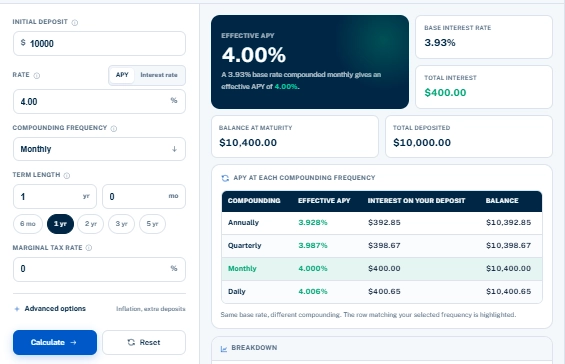
Enter an APY, or a base rate plus compounding, to see your true annual yield.
Your inputs changed. Press Calculate to update the results.
Effective APY
—
APY at each compounding frequency
Same base rate, different compounding. The row matching your selected frequency is highlighted.
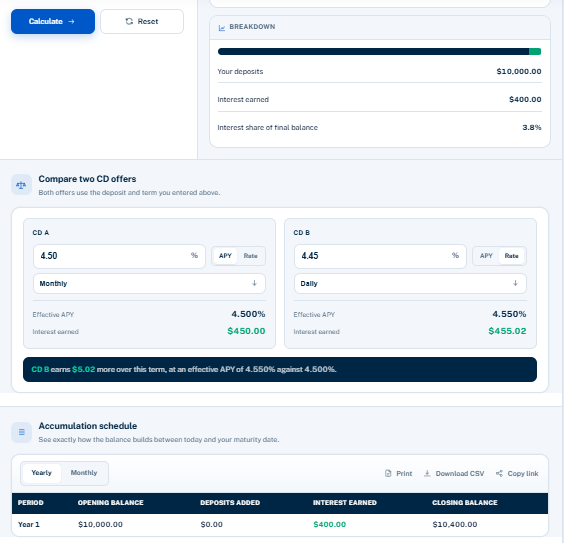
Compare two CD offers
Both offers use the deposit and term you entered above.
Compare two CD offers
Both offers use the deposit and term you entered above.
CD A
CD B
Accumulation schedule
See exactly how the balance builds between today and your maturity date.
Results are estimates based on the values you enter. Confirm the quoted APY, base rate and compounding frequency with your bank or credit union before opening a CD.
A CD APY calculator shows your true annual return on a certificate of deposit after compounding is included. Enter your deposit, the APY or base rate, the term, and the compounding frequency to see your interest earned and final balance. It also converts a bank's base interest rate into the APY you will actually earn.
How to Use the CD APY Calculator
Each step below matches a field in the tool above, in the order it appears.
-
1
Enter your initial deposit
The amount you would place into the CD.
-
2
Enter the rate and pick APY or interest rate
Choose APY if your bank quoted an APY. Choose Interest rate if it quoted a base rate, and the calculator converts it.
-
3
Choose the compounding frequency
Daily, monthly, quarterly, semi-annually or annually. This is what turns a base rate into an APY.
-
4
Set the term length
Enter years and months, or tap one of the quick terms.
-
5
Add your marginal tax rate
Optional. Leave it at zero to skip tax, or enter your rate to see the interest after tax.
-
6
Press Calculate
The results do not change while you type. Set every field, then press Calculate.
What Is APY on a CD?
APY stands for annual percentage yield, the total return a CD earns in one year once compounding is included. It reflects what you actually earn, not just the headline rate. Because interest earns further interest during the year, the APY is usually a little higher than the base rate.
Banks advertise CDs in APY because it gives savers a single, standardized figure to compare. Two CDs with the same base rate can carry different APYs if they compound at different frequencies. The APY captures that difference in one number.
APY vs Interest Rate: What Is the Difference?
The interest rate is the base annual rate a bank pays, while the APY is the effective rate after compounding is applied across the year. The base rate ignores compounding, so it understates what you actually earn. The APY includes it, so it reflects your true return.
For example, a 4.40% base rate compounded monthly produces an APY of about 4.49%. On a $10,000 deposit, that is roughly $449 in a year rather than $440. The gap comes entirely from interest earning interest during the year.
This is why comparing one CD's base rate against another CD's APY gives a misleading result. Always compare APY to APY. If a bank only shows a base rate, convert it first.
APY vs APR: Why They Are Not the Same
APY and APR look similar but measure opposite sides of a transaction. APY applies to money you earn, such as CDs and savings accounts, and it includes compounding. APR applies to money you borrow, such as loans and credit cards, and it does not include compounding in the same way.
For a saver, APY is the relevant figure. A CD quoted at a 4.50% APY earns more than a product quoted at a 4.50% APR compounded monthly, because APY already accounts for the compounding effect. When you research CDs, focus on APY and ignore APR, which belongs to borrowing products.
The APY Formula and How to Calculate It
You can calculate APY from a base rate with a single formula. The APY equals (1 + r / n) raised to the power of n, minus 1. Here r is the base annual rate as a decimal, and n is the number of compounding periods per year. Multiply the result by 100 to express it as a percentage.
Take a 4.00% base rate compounded monthly. Set r as 0.04 and n as 12, so the APY equals (1 + 0.04 / 12)^12 minus 1, which is 4.074%. The same 4.00% rate compounded daily produces an APY of about 4.081%. More frequent compounding always yields a slightly higher APY.
The calculator above runs this formula for you and shows the resulting earnings. For a deeper look at how compounding frequency changes your interest, see our CD interest calculator.
How to Compare Two CDs Using APY
APY is the only fair way to compare CDs from different banks, because it standardizes rate and compounding into one figure. A CD with a lower advertised number can actually pay more once both are expressed as APY.
Consider the two offers below on a $10,000 deposit held for one year. CD A advertises a 4.50% APY. CD B advertises a 4.45% base rate compounded daily, which works out to a higher APY.
| CD Offer | Advertised | Compounding | Effective APY | Interest on $10,000 (1 Year) |
|---|---|---|---|---|
| CD A | 4.50% APY | Already APY | 4.50% | $450.00 |
| CD B | 4.45% base rate | Daily | 4.55% | $455.03 |
CD B earns $5.03 more over the year, even though its advertised rate looks lower. Without converting to APY, a saver might pick the wrong CD. Run both offers through the calculator to see which one truly pays more.
Does APY Change During Your CD Term?
For a standard fixed-rate CD, the APY is locked when you open the account and stays the same for the full term. This is a core advantage of CDs, since your return does not fall if market rates drop. You know your exact yield from day one.
Some CD types work differently. A variable-rate CD can see its APY move with an index, and a bump-up CD lets you raise the rate once during the term. For these, the starting APY is not guaranteed for the whole term. Always confirm whether your CD carries a fixed or variable APY before you commit.
Frequently Asked Questions
Use the formula APY = (1 + r / n)^n minus 1, where r is the base annual rate as a decimal and n is the number of compounding periods per year. For a 4.00% rate compounded monthly, the APY is (1 + 0.04 / 12)^12 minus 1, which equals 4.074%. Daily compounding on the same rate gives about 4.081%. A CD APY calculator does this conversion automatically once you enter the rate and frequency.
No, they are different figures. The interest rate is the base rate before compounding, while the APY is the effective yearly return after compounding is applied. The APY is usually slightly higher because interest earns further interest during the year. When comparing CDs, always use APY, since it reflects what you actually earn.
Yes, at the same deposit and term, a higher APY always earns more interest, because APY already accounts for compounding. This makes it a reliable comparison figure across banks. However, a longer term or a larger deposit also affects your total return, so match the APY comparison to CDs of the same term and amount.
A good APY is one that beats the national average and the rates at your current bank. Online banks and credit unions often pay more than large brick-and-mortar banks, because they carry lower overhead. Rates also shift with the wider economy, so compare current APYs at several institutions before opening. As a rule, gather at least three offers and compare them as APY.
On a standard fixed-rate CD, yes, the APY is locked when you open the account and does not change for the full term. This guarantees your return even if market rates fall. Variable-rate CDs and bump-up CDs are exceptions, since their APY can change during the term. Confirm the CD type before you commit your money.