Traditional CD
Pays a fixed rate for a fixed term, with a penalty for early withdrawal. This is the standard option most banks offer.
Free CD calculator
CD Calculator
Enter your deposit, term and rate to see your balance at maturity.
Your inputs changed. Press Calculate to update the results.
Balance at maturity
—
Accumulation schedule
See exactly how the balance builds between today and your maturity date.
Results are estimates based on the values you enter. Confirm the APY, term and compounding frequency with your bank or credit union before opening a CD.
Explore our full set of tools to plan every part of your CD strategy.
A CD calculator shows how much a certificate of deposit will earn by its maturity date. Enter your deposit amount, term length, interest rate or APY, and compounding frequency to see your total interest and final balance. Use it to compare terms and plan your savings before you open an account.
The calculator needs four figures, and two optional ones if you want a sharper picture. Each step below matches a field in the tool above, in the order it appears.
Enter your initial deposit
The amount you place into the CD when you open it. Type the number only, the dollar sign is already in the field.
Enter the rate, then pick APY or interest rate
Use the toggle beside the label to match what your bank quoted. APY already includes compounding, a base interest rate does not, and mixing the two is the most common cause of a wrong result.
Choose the compounding frequency
Daily, monthly, quarterly, semi-annually or annually, as stated in your account disclosure.
Set the term length
Enter years and months, or tap one of the quick terms for 6 months, 1, 2, 3 or 5 years.
Add your marginal tax rate, if you want it
CD interest is taxed as ordinary income. Leave it at zero to skip tax, or enter your rate to see what the interest is worth after tax.
Press Calculate
The figures do not change while you type. Press Calculate and the results refresh, so you can set every field first and compare one scenario against another.
Your balance at maturity appears first, with total interest, total deposited and the effective APY beside it. The Growth tab charts your deposit and interest period by period, and the Breakdown tab shows how much of the final balance is interest.
Under the tool, the accumulation schedule lists every period in full. Switch between the yearly and monthly views, and use Print, Download CSV or Copy link to keep the figures or share them. Advanced options adds a monthly contribution, expected inflation and a savings APY to compare against.
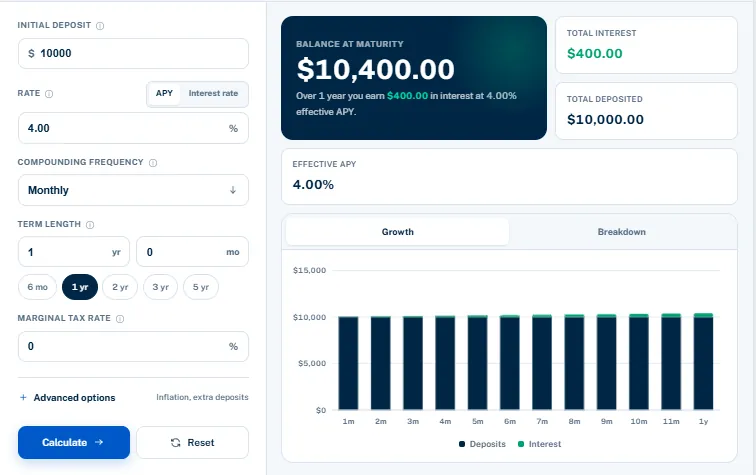
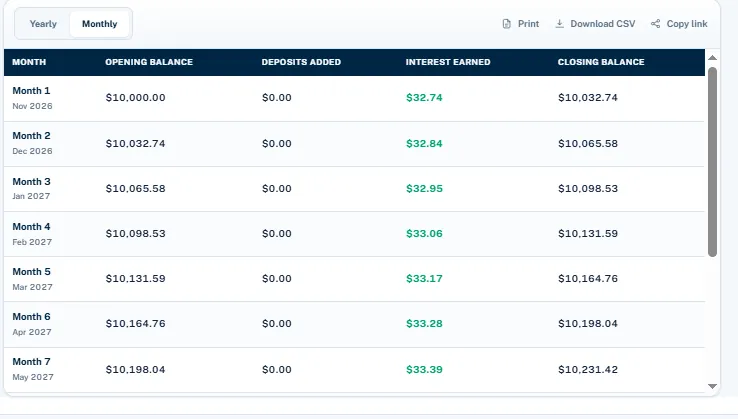
A certificate of deposit is a savings product that pays a fixed interest rate for a fixed period of time. You agree to leave your money untouched until a set maturity date, and in return the bank pays a guaranteed return. Terms usually range from three months to five years or longer.
CDs sit at the low-risk, low-return end of the savings scale. The rate is locked for the full term, so your return does not change even if market rates fall. This predictability is the main reason savers choose CDs over variable-rate accounts.
In exchange for that guaranteed rate, your money is committed for the term. Withdrawing early normally triggers a penalty, so a CD suits money you will not need until the maturity date.
CD interest is calculated with the compound interest formula, which grows your balance on both the principal and the interest already earned. The core formula is A = P x (1 + APY) raised to the power of t, where P is your deposit, APY is the annual percentage yield, and t is the term in years. The more often interest compounds, the slightly higher your final balance.
This page gives the short version. For the full formula, worked monthly examples, and simple versus compound interest explained step by step, use our dedicated CD interest calculator.
The interest rate is the base annual rate, while the APY is the effective yearly return after compounding is included. APY is always equal to or higher than the base rate, which is why it is the number you should compare between banks. A common mistake is entering the base rate into a calculator when the bank quoted an APY.
To convert a base rate to APY, or to compare two CDs on a true like-for-like basis, use our CD APY calculator.
Compounding frequency is how often the bank adds earned interest back to your balance. Common intervals are daily, monthly, quarterly, and annually. As a general rule, more frequent compounding produces a slightly larger return at the same rate.
The difference is small on short terms but grows over multi-year CDs. You can model each interval on our CD interest calculator.
The table below shows what a $10,000 deposit would earn at an example APY of 4.00%, held to maturity. These figures are illustrative, so enter your bank's actual APY in the calculator above for exact numbers. Longer terms earn more because interest compounds over a greater period.
| CD Term | Deposit | Example APY | Interest Earned | Balance at Maturity |
|---|---|---|---|---|
| 6 months | $10,000 | 4.00% | $198.04 | $10,198.04 |
| 1 year | $10,000 | 4.00% | $400.00 | $10,400.00 |
| 2 years | $10,000 | 4.00% | $816.00 | $10,816.00 |
| 3 years | $10,000 | 4.00% | $1,248.64 | $11,248.64 |
| 5 years | $10,000 | 4.00% | $2,166.53 | $12,166.53 |
A one-year CD on $10,000 at 4.00% APY returns $400 in interest. Over five years, the same deposit and rate returns $2,166.53, because each year's interest earns interest of its own. This is the compounding effect working in your favor.
Real returns depend on the APY your bank offers and the term you choose. Longer terms usually pay higher rates but lock your money away for longer, so match the term to when you will need the funds.
Not every CD works the same way. The main types below suit different goals and levels of flexibility.
Pays a fixed rate for a fixed term, with a penalty for early withdrawal. This is the standard option most banks offer.
Lets you withdraw your full balance before maturity without a penalty. The rate is usually lower, but the flexibility suits uncertain timelines.
Allows you to raise your rate once during the term if your bank's rates increase. It starts at a slightly lower rate in exchange for that option.
Requires a large minimum deposit, often $100,000 or more, and typically pays a higher rate. It suits savers with a large lump sum.
Bought through a brokerage rather than directly from a bank. It gives access to a wider range of rates and terms from many institutions.
Pays no periodic interest and is bought below face value. You receive the full face value at maturity, which suits long-term goals.
A CD ladder is a strategy that splits your money across several CDs with staggered maturity dates. For example, instead of one five-year CD, you open CDs maturing in one, two, three, four, and five years. As each one matures, you gain access to a portion of your money or reinvest it at current rates.
This gives you regular access to funds while still earning longer-term rates. To plan the exact rungs and returns, use our CD ladder calculator.
CDs are among the safest savings products available in the United States. A CD from an FDIC-insured bank is protected up to $250,000 per depositor, per institution, per ownership category. If the bank fails, your insured balance is guaranteed by the federal government.
Credit unions offer the same protection through the National Credit Union Administration, known as NCUA insurance. The coverage limit and structure are effectively identical to FDIC coverage. Always confirm your institution carries FDIC or NCUA insurance before opening a CD.
If you hold more than $250,000, you can spread deposits across separate insured institutions to keep every dollar covered. This is a common approach for savers with large balances.
A CD is not the only low-risk place to hold savings. The options below may suit you better depending on your need for access and yield.
Offers a competitive rate with full access to your money at any time. The rate is variable, so it can rise or fall.
Combines savings interest with limited check-writing or debit access. It is FDIC insured and suits money you may need occasionally.
Bills, notes, and bonds issued by the US government. They are highly secure and the interest is exempt from state income tax.
Clearing a balance that charges more than a CD pays is effectively a guaranteed return. This often beats any low-risk investment.
A $10,000 CD earns $400 in one year at a 4.00% APY. At a 5.00% APY the same deposit earns $500, and at 3.00% it earns $300. The exact amount depends entirely on the APY your bank offers and whether you hold the CD to maturity. However, withdrawing before the maturity date usually triggers a penalty that reduces your interest.
A five-year CD earns significantly more than a short-term CD because interest compounds over a longer period. A $10,000 deposit at a 4.00% APY grows to about $12,166 over five years, an interest gain of $2,166. The longer term is the main driver, since each year's interest earns further interest. Keep in mind that locking money for five years means less flexibility if rates rise during the term.
The best CD term is the one that matches when you will need your money. Short terms of six months to one year suit near-future goals, while three to five year terms suit money you can set aside longer. Longer terms often pay higher rates, but they also lock your funds away for longer. However, in a falling-rate environment, locking a longer term can protect a strong rate before new rates drop.
You cannot lose your principal in an FDIC or NCUA insured CD held to maturity. The one way to lose value is withdrawing early, since the penalty can eat into your interest and, in some cases, part of your deposit. Inflation can also reduce your real return if the rate is lower than the inflation rate. You can estimate the cost of an early exit with our CD early withdrawal penalty calculator.
Yes, CD interest is taxed as ordinary income in the year it is earned, even if you do not withdraw it. Your bank reports the interest on a Form 1099-INT once it exceeds $10 in a year. Interest inside a tax-advantaged account, such as an IRA CD, is treated differently. However, tax rules vary by situation, so confirm the details with a qualified tax professional.
When a CD matures you enter a short grace period, usually seven to ten days, to decide what to do next. You can withdraw the principal and interest, move it to another account, or open a new CD. If you take no action, most banks automatically renew the CD at the current rate. You can model the value of a renewal with our CD maturity calculator.
Enter your own deposit, term and APY to see your balance at maturity, your total interest, and what it is worth after tax and inflation.